- Lab Notes
- SEO
- AEO
- Audit
SEO Audit Log: OG Images, H1s, and What Google Sees on a New Site
A documented first audit of jjcruzgalera.com covering OG image setup, H1 targeting, and Search Console baselines. Five issues found, two fixed in the same session.
What this is
This site is a public SEO and GEO experiment. That means documenting what gets tested, what gets fixed, and what the data shows, including the starting point when the numbers are embarrassing.
This is the first audit log. It covers what was found, what was fixed, and what the baseline looks like before any of it has time to compound.
The baseline: what Google sees right now
Before touching anything, here is what Google Search Console showed for jjcruzgalera.com as of June 17, 2026, across a 3-month window:
- Total clicks: 1
- Total impressions: 7
- Average CTR: 14.3%
- Average position: 5.6
- Pages indexed: 1 (the homepage only)
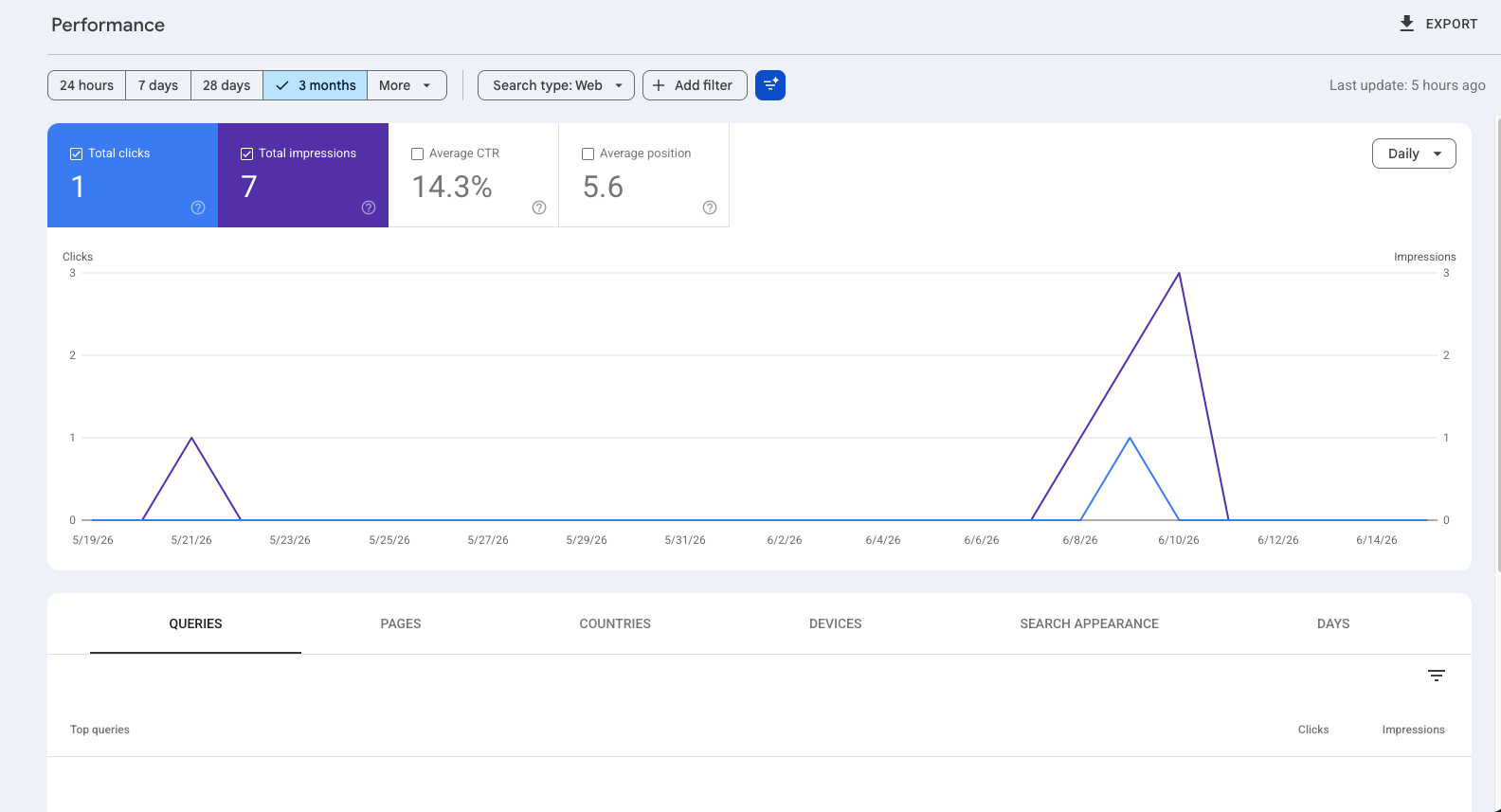
One page indexed out of five crawled. Seven impressions. One click. That is the starting point.
The 14.3% CTR is the one number worth noting. When the site did appear in results, someone clicked (thank you for your kindness, and we haven't even made it to page 2 yet). That suggests the result was relevant to the query, even if the query data is too thin to surface in the console yet. Position 5.6 on a brand new domain with no inbound links is also a reasonable starting point.
Everything else is a gap to close.
Five issues found
The audit covered the homepage, all three playbook posts, the Lab Notes index, the About page, and the Tools section. Five issues identified, prioritized by impact:
1. OG image was broken sitewide. Every page was passing favicon.png as the Open
Graph image instead of a proper 1200x630 image. The bug was in BaseLayout.astro: the
ogImage prop was declared and defaulted correctly, but both the og:image and
twitter:image meta tags were hardcoded to the favicon path, ignoring the prop entirely.
Every link shared from this site was generating a broken social preview card.
2. H1s and meta descriptions were not targeting any searchable query. The homepage H1 was "Performance marketing, in the open." A strong brand line, but a useless SEO signal. None of the top-level pages contained a phrase that a practitioner would actually type into Google or an AI engine.
3. Lab Notes is empty but indexed. The section exists, it is in the sitemap, Google can crawl it, and it says "First posts coming soon." An empty indexed page is a mild crawl budget waste and a real E-E-A-T problem.
4. No structured data on playbook posts. The playbook posts are long-form, step-by-step content. Neither the HowTo schema nor the Article schema is present on any of them. For AEO specifically, structured data is how you signal to Google and AI engines that a page is the canonical answer to a procedural question.
5. Zero inbound links. No external sites linking to any page. For both SEO and GEO, external citation is the multiplier. Without it, even well-optimized content stays invisible to discovery. This one will take awhile, since I'm going to avoid posting on LinkedIn.
What was fixed in this session
OG image: Designed a 1200x630 dark background image matching the site footer
(#1a1a19), with the J lettermark, site headline, byline, and blue accent bar (#2563eb).
Uploaded to public/og-image.png. A Claude Code prompt was written to fix the meta tag
bug in BaseLayout.astro so the {ogImage} variable is used instead of the hardcoded
favicon path.
Homepage H1 and meta description: H1 updated from "Performance marketing, in the open." to "B2B Paid Media Playbooks for Performance Marketers." The original brand line is retained as an h2 subheading directly below. Meta description updated to: "Practical playbooks, tools, and honest writing on paid media attribution, A/B testing, and growth marketing for B2B SaaS marketers."
Both changes are live on main as of today.
What is still open
- BaseLayout meta tag fix: Claude Code prompt written, not yet committed
- Lab Notes: this post resolves the empty section problem
- HowTo and Article schema on playbook posts
- Inbound links: zero, no fix for this in a single session
The hypothesis
Fixing the OG image and H1 targeting will improve indexed page count and average position within 60 days. (Fingers crossed.)
The next audit log will run in 30 days against the same Search Console metrics used here as a baseline.
Terminology
OG image (Open Graph image): A 1200x630 pixel image attached to a page via meta tags that platforms like LinkedIn, Slack, and X use to generate link preview cards. Without one, shared links render as broken or blank previews.
H1: The primary heading tag on a webpage. Search engines weight it heavily when determining what a page is about. One H1 per page, and it should contain the core keyword phrase you want the page to rank for.
Meta description: The short text snippet that appears below a page title in search results. It does not directly affect rankings but influences click-through rate. It should match the search intent of the query you are targeting.
E-E-A-T: Experience, Expertise, Authoritativeness, and Trustworthiness. Google's framework for evaluating content quality. A site with original data, a named author, and external citations scores higher than anonymous, derivative content.
Structured data: Code added to a page in JSON-LD format that explicitly tells search engines what type of content the page contains: an article, a how-to guide, a product, a person. For AEO, it increases the probability that your content gets surfaced as a direct answer.
AEO (Answer Engine Optimization): The practice of structuring content so it gets selected as a direct answer in search results, featured snippets, People Also Ask boxes, and AI-generated responses.
GEO (Generative Engine Optimization): The practice of optimizing content so it gets cited or referenced in AI-generated answers from tools like ChatGPT, Perplexity, Google AI Overviews, and Claude. Original data, named authorship, and external citations are the strongest signals.